A note from Jack's series — to you
your kid is ready for this.
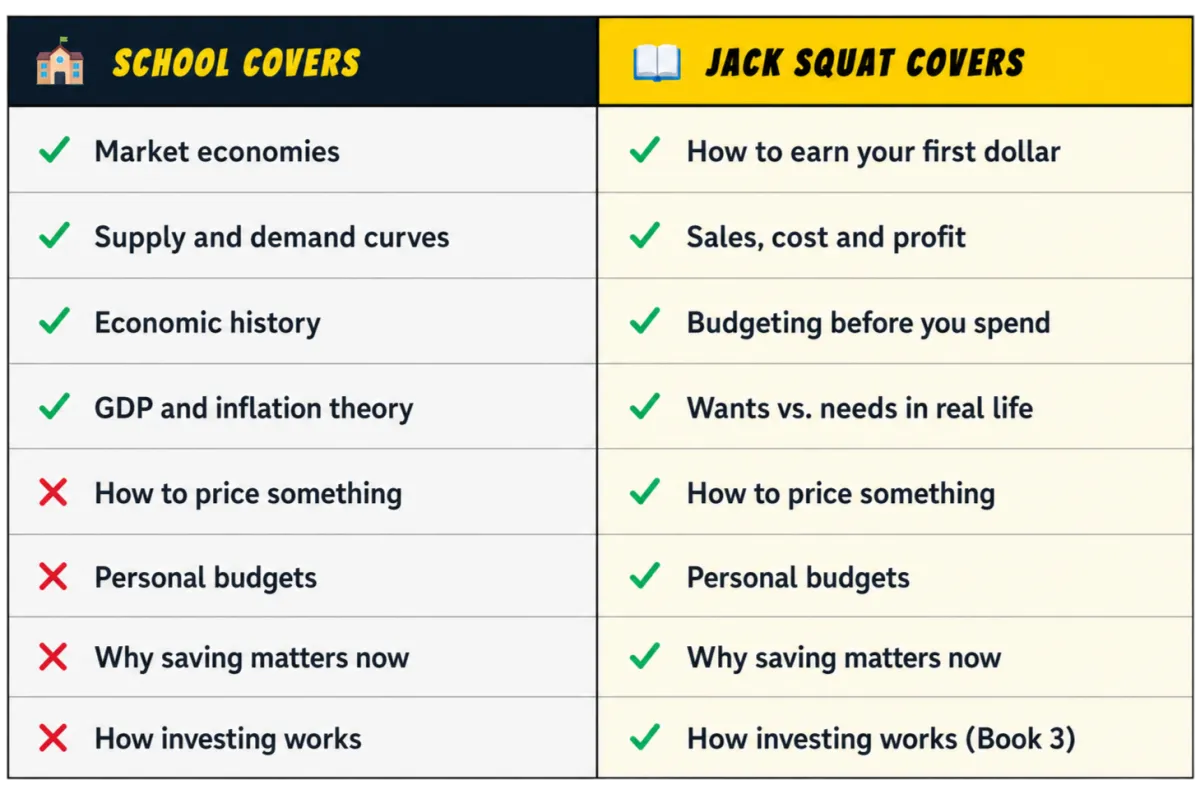
Schools teach market economies. They skip profit. They explain supply and demand. They skip budgets. They cover economic history. They skip how to earn your first dollar.
The Jack Squat series covers what was missed — for ages 8 to 13, in a way they'll actually read.
📚 Ages 8–13
Written for real kids — not dumbed down
i
💡 1 Big Lesson
Per book. Focused. Memorable. Applicable.
i
✍️ real worksheets
Every book ends with a plan kids fill out themselves.
i
💰 real worksheets
Redeemable — sparks a real conversation about earning
The problem
what school covers.
what it doesn't
Most financial literacy comes from either (a) parents, who often weren't taught either, or (b) school curricula that cover macro-economics and skip the practical stuff. By the time kids hit adulthood, they've studied Adam Smith and never balanced a personal budget.
Jack Squat doesn't pretend to fix the entire system. It fills the gap that matters most for an 8–13 year old: the distance between understanding that money exists and understanding how to actually work with it.
The approach
why kids actually
read it.
THE FORMAT
JACK GETS THINGS WRONG FIRST.
Every lesson starts with Jack making a mistake. Losing 75 cents on his first lemonade stand, watching his money disappear without knowing where it went. Kids feel seen. And they remember the fix more because they felt the problem first.
THE voice
not preachy. not simplyfied.
Jack is genuinely funny. He notices that the neighbour's dog has a sweater and he can't afford snacks. He notices that his teacher spent three weeks explaining nothing useful. The humour is real, not performed for kids, but written like a kid would actually think.
THE scoop
one lesson. one book. Done.
No sprawling curricula. No 20-chapter workbook that nobody finishes. Each book has a single clear lesson that a kid can hold in their head when they close it. That focus is intentional — children learn by depth, not by breadth.
In every book
what comes
with every copy.
📖 THE STORY
A COMPLETE ADVENTURE
Jack's full story for that book. Written with real humour, real mistakes, and a real lesson woven through. Not a textbook with a cartoon cover. An actual story kids finish voluntarily.
💭 THE lesson
three ways to say it
Pops McGee's napkin. Freckles' notebook. Jack's own words. The core lesson is presented three different ways so it sticks in whatever format works for your kid's brain.
What parents say
from the porch.
Common questions
things
parent ask.
Can't find your question here? The answer is probably simpler than you think, but email us and we'll sort it out.
IS THIS ACTUALLY FOR KIDS, OR JUST A PARENTING BOOK?
Genuinely for kids. Jack is the narrator, the protagonist, and the voice throughout. The books are written in Jack's perspective — his thought bubbles, his confusion, his wins. Parents often find themselves reading along, but the primary audience is your 8–13 year old.
DO I NEED TO READ IT WITH THEM, OR CAN THEY READ ALONE?
Either works. Kids 10 and up typically read solo and come to parents with questions — which is often the best outcome. Younger readers in the 8–9 range may enjoy reading together, and the conversation starters in each book are designed to help you pick up the thread afterward. The certificate requires a parent signature, which naturally creates a moment of connection.
MY KID ISN'T A BIG READER. WILL THEY ACTUALLY FINISH IT?
The books are designed for exactly that kid. Short chapters. Jack's internal monologue breaks up the text. Illustrations carry a lot of the story. The humour is genuine — not "here's a funny word to keep you engaged" humour, but real comedy about real situations. Most kids who pick it up finish it. The ones who don't usually restart it.
DO THE BOOKS HAVE TO BE READ IN ORDER?
They work best in sequence — each book builds on the last. Book 1 teaches earning; Book 2 teaches keeping what you earn; Book 3 teaches growing it. That progression is intentional. That said, each book stands alone, and a child who starts at Book 2 won't be lost.
CAN THESE BE USED IN A CLASSROOM?
Yes. Several teachers have used them as a jumping-off point for practical economics and entrepreneurship units. Each book's worksheet is classroom-ready. If you're a teacher or school looking to order in bulk, get in touch and we'll work something out.
WHAT AGE IS THE SWEET SPOT?
The sweet spot is 8–12. Old enough to engage with concepts like profit and budgets, young enough for these habits to form naturally before the financial decisions get real. That said, confident 8-year-olds read it comfortably, and plenty of 13-year-olds have found it genuinely useful — including a few parents who'd rather not admit how much they learned from a book about a lemonade stand.
Start the conversations
give them
the head start
you didn't get
The stuff that matters most about money isn't taught in school. But it can be learned from a scruffy dog, a sleepy grandpa, and a friend with a colour-coded notebook — if you hand them the right book.


